The complexities of immigration reform

Beyond the headlines, we’re digging into questions that really matter: Why hasn’t the U.S. fixed its immigration system—and how can we be part of the solution?
Watch the video and learn more
For decades, leaders in Washington have debated comprehensive immigration reform, a sweeping effort to fix every part of the system at once: how people come here, how they work, and what happens to the millions already building their lives in the United States.
It’s a vision that would reshape the American immigration system in a meaningful, lasting way. And yet, despite years of negotiations and moments of real momentum, it has never become law.
The result is a system that remains deeply uncertain for newcomer families, for Welcomers, and for communities across the country.

To understand why, we sat down with Cecilia Muñoz, a leading voice on immigration policy who has worked at the highest levels of government and policymaking. As Director of the White House Domestic Policy Council under President Obama, a longtime immigration reform advocate, and now co-founder and co-chair of Welcome.US, she has been at the center of the biggest bipartisan efforts to shape immigration policy in recent decades.
In this video, Cecilia shares that America’s divide on immigration is merely a political myth. In fact, a strong majority of Americans—about 7 in 10—support safe, orderly, and legal immigration. She breaks down the real story behind why comprehensive immigration reform has remained out of reach—and what it would take to finally make it happen.
What does “immigration reform” mean?
There are two types of immigration reform that policymakers can undertake: comprehensive and incremental. Comprehensive reform attempts to fix the entire system through a single omnibus bill, while incremental reform targets specific groups or issues through separate, smaller bills.
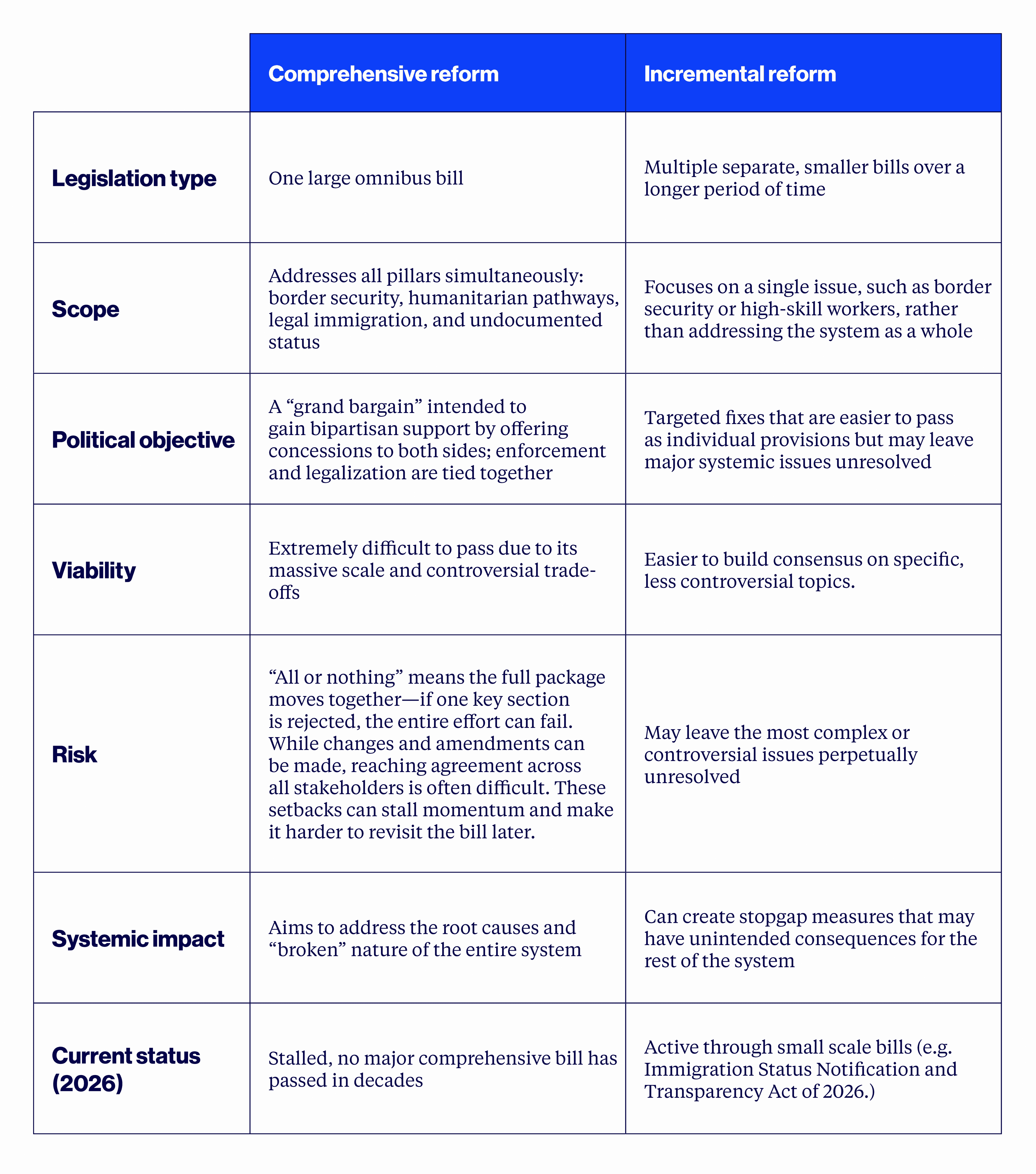
Summary of key differences
Comprehensive approach
A comprehensive approach emphasizes the interconnectedness of immigration issues; addressing them in isolation can create unintended consequences. For example, increasing immigration enforcement without addressing legal visa programs can inadvertently increase unauthorized border crossings.
Incremental approach
An incremental approach is often seen as a way to improve the system after years of legislative gridlock. This allows for immediate improvements for specific vulnerable populations, such as newcomers who were sponsored through humanitarian parole, rather than waiting for the outcome of a massive bill that may never pass.
What is the history of immigration reform efforts in the U.S?
Since the last successful major overhaul in 1986, several bipartisan attempts at comprehensive immigration reform (CIR) have advanced through the legislative process but ultimately failed.
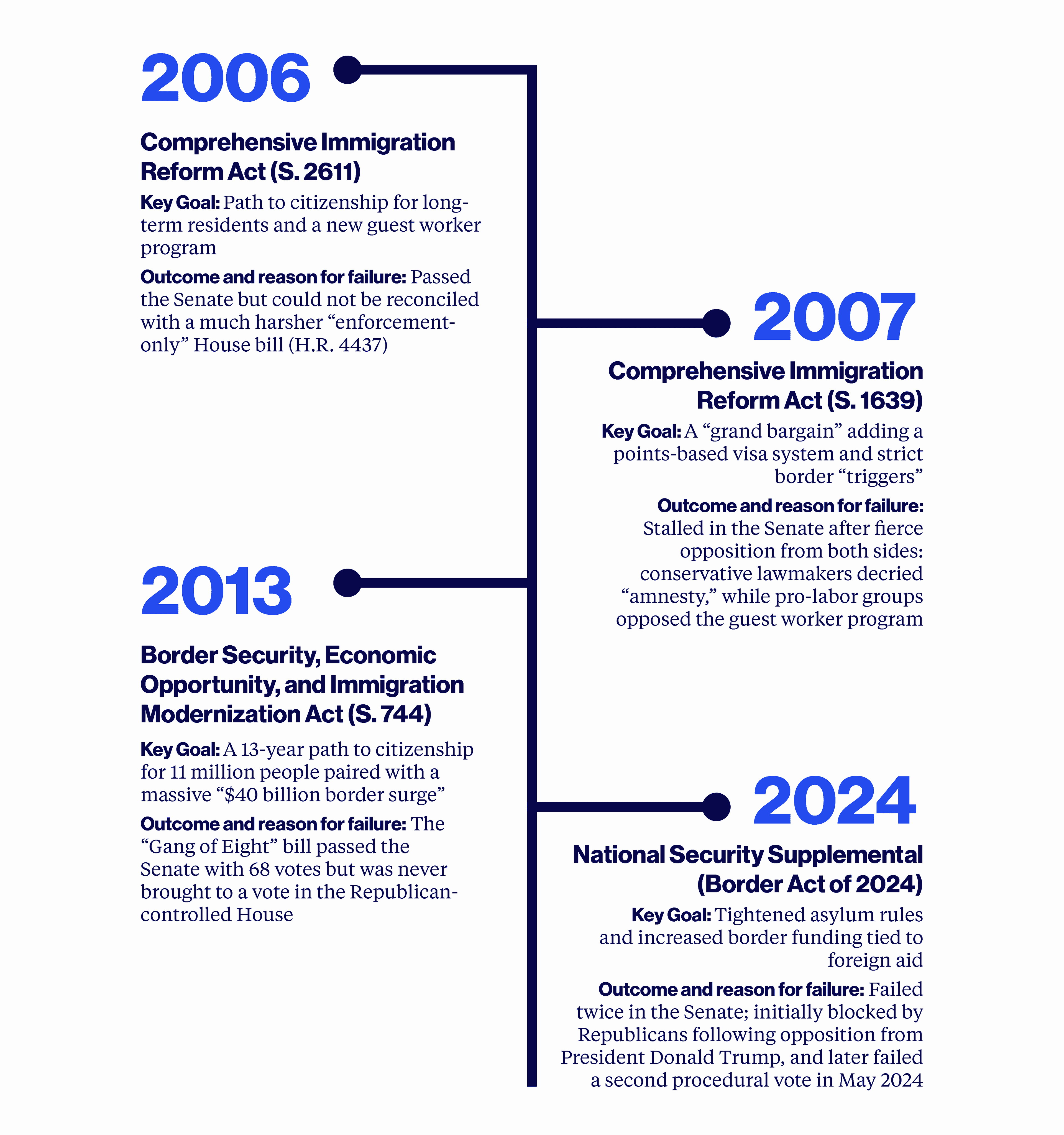
Recurring reasons for failure
"Amnesty" label
Many conservative lawmakers view any path to legal status for undocumented immigrants as a reward for unlawful behavior, making bipartisan compromise difficult.
Labor disputes
Democrats and labor unions generally oppose expanded guest worker programs because they believe these programs bypass the domestic labor market, which could lower wages and reduce job opportunities for American workers, while also leaving guest workers vulnerable to exploitation due to their limited legal rights.
House-Senate disconnect
In several cases (including in 2006 and 2013), one chamber passed a comprehensive bill while the other chamber refused to consider it or passed a drastically different version.
Political timing
Major bills often collapse near election cycles as the issue becomes a central campaign talking point, leading to increased polarization.
What was the last major overhaul of immigration policy in the U.S.?
The last successful major overhaul of immigration policy in the U.S. was the Immigration Reform and Control Act of 1986 (IRCA), also known as the Simpson-Mazzoli Act. Signed into law by President Ronald Reagan on Nov. 6, 1986, it was a bipartisan "grand bargain" that aimed to address unauthorized immigration through three main pillars:
Three main pillars
Amnesty for undocumented immigrants
It granted legal status to approximately 2.7 to 3 million people who could prove they had resided in the U.S. continuously since before Jan. 1, 1982.
Employer sanctions
For the first time in U.S. history, it became illegal for employers to knowingly hire or recruit undocumented immigrants. It introduced the I-9 Form, requiring employers to verify the identity and work eligibility of all new hires.
Increased enforcement
The law significantly boosted funding and resources for the U.S. Border Patrol and the Immigration and Naturalization Service (INS) to curtail future illegal entries.
Additional key provisions
- Special agricultural workers (SAW): This created a separate legalization path for seasonal farmworkers who had worked at least 90 days in qualifying agricultural labor during the year ending May 1, 1986.
- Visa programs: They established the H-2A and H-2B visa categories for temporary agricultural and non-agricultural workers.
- Visa waiver pilot: This launched the first version of the visa waiver program, allowing citizens from certain countries to enter for up to 90 days without a visa.
While the act successfully legalized 2.7–3 million people, critics and historians often note that its enforcement measures (specifically employer sanctions) were poorly funded and largely ineffective at stopping the growth of the undocumented population over the following decades.
Policymakers can’t seem to agree, but what do Americans think about immigration reform?
While policymakers remain divided, public opinion tells a more consistent story. Across multiple national surveys, most Americans support a balanced approach to immigration reform—combining stronger border enforcement with legal pathways for people already living in the U.S. Gallup polling has consistently found that a pathway to citizenship is favored over mass deportation when Americans are given policy choices.
Public opinion tells a different story.
There is also broad agreement on the value of immigration itself. According to Gallup, a majority of Americans say immigration is a “good thing” for the country, with near record high support for it in recent years.
At the same time, Americans express real concerns about how the system is functioning. In 2024, Gallup found that immigration ranked as the most important problem facing the country for the first time in decades. Pew Research also finds that large shares of Americans say border management is a major priority, reflecting concern about how the system operates.
On legal immigration, there is a notable middle ground. Pew data shows that nearly half of Americans say legal immigration levels should either stay the same or increase, rather than decrease, suggesting openness to immigration when it is orderly and well managed.
Taken together, the data points to a striking reality: The American public is often less polarized than the politics of immigration. Many Americans simultaneously support enforcement and inclusion, favoring solutions that combine security, fairness, and economic need.
And yet, that broad consensus has not translated into law.
Learn more about this topic through these suggested resources:
- On Immigration, A Clear and Just Vision Requires Wrestling With Hard Questions- Cecilia Munoz, Roosevelt Institute
- How the United States Immigration System Works - American Immigration Council
- Reforming the Immigration System: A Brief Outline - David J. Bier, CATO Institute
- Immigration beyond the extremes: a blueprint that actually works - Niskanen Center
- Has Congress Given Up on Bipartisan Immigration Reform? A Data-Driven Look at Legislation Since 2015 - Theresa Cardinal Brown, Bipartisan Policy Center