Who gets to decide immigration reform?

Beyond the headlines, we’re digging into questions that really matter: Who gets to decide immigration reform?
Temporary Protected Status (TPS) is granted to individuals from countries facing crises like war or natural disasters. This form of humanitarian protection that was established by Congress authorizes the Department of Homeland Security (DHS) to allow these individuals to temporarily live and work in the U.S. after undergoing thorough vetting.
Haitians rely on TPS for refuge in the U.S. because of ongoing political instability, violence, and the impacts of natural disasters that have gripped the nation for many years. If TPS for Haitians ended, they would be forced to return to a country in turmoil that the U.S. Department of State has designated as having the highest risk for travelers.
While different branches of government debate whether this crucial protection should be extended, your voice can make a difference.

What happened recently?
In early 2025, DHS announced plans to end TPS for Haitians—a decision that would force 350,000 Haitian immigrants to return to a country in crisis.
Lower courts blocked this decision, keeping protections in place for now. The Supreme Court has agreed to hear the case, with oral arguments on April 29, 2026. A decision is expected by the last week of June when the Court concludes its current term. Until then, Haitian TPS holders can continue to live and work legally in the U.S.
At the same time, a bipartisan group of House members agreed to vote on a new bill to extend TPS for Haiti through 2029, allowing Haitian newcomers to continue living and working here with temporary status. The House of Representatives will vote on the bill this month, perhaps as early as this Wednesday. If it passes, it will move to the Senate for consideration, and then the president would either sign it into law or veto it. If the president vetoes the bill, it would return to Congress where members of Congress could attempt to override the veto with a two-thirds vote in both the House and Senate. If they fail to reach the threshold, the bill would not become law.
Who gets to decide immigration reform and policy in the United States?
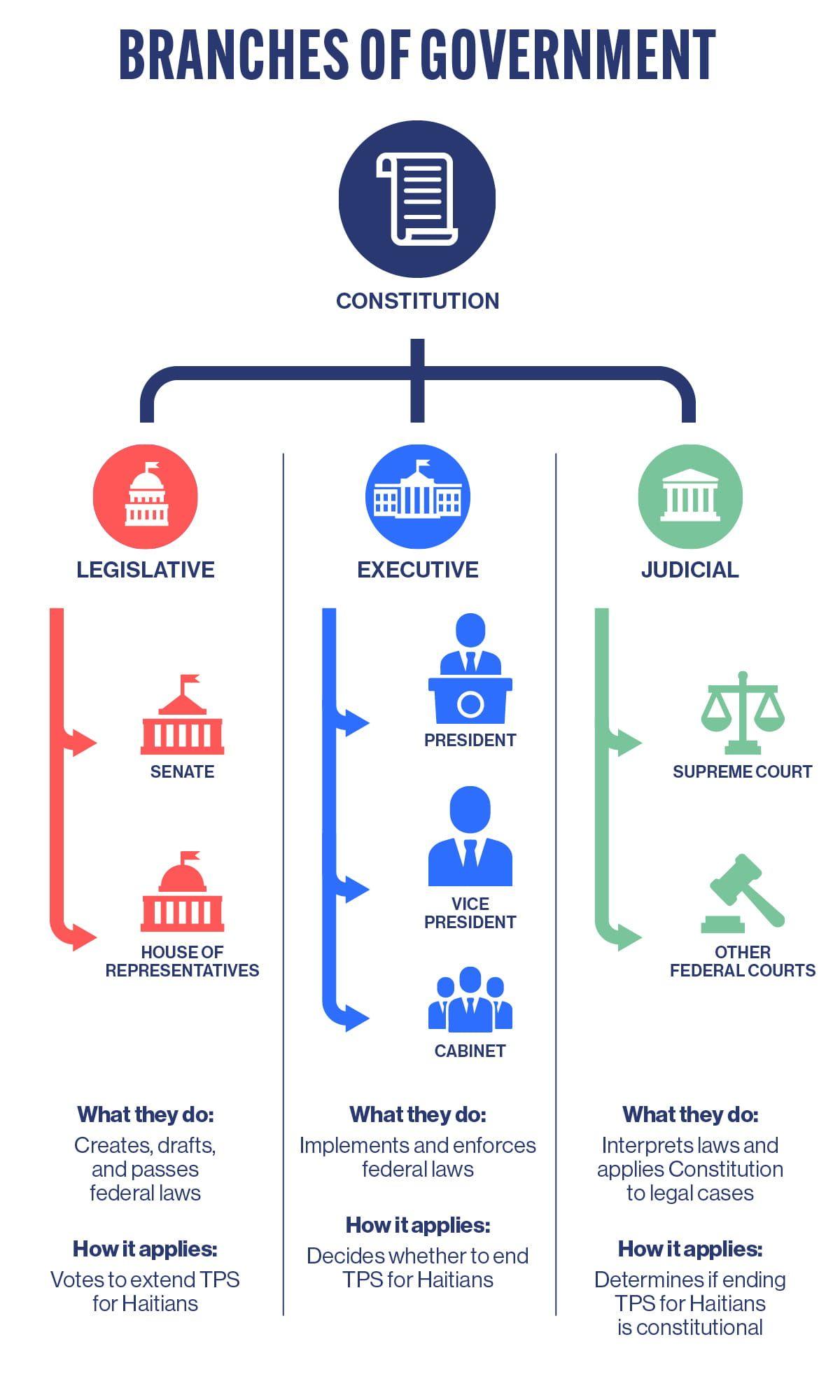
What does each branch of government do?
Legislative (Senate and House of Representatives)
- Writes and votes on bills that may become law
- Holds the primary authority by drafting and passing immigration law that defines, restricts, or expands programs like TPS and humanitarian parole
- Most closely represents the people, which is why your voice matters
Executive (the president and federal agencies, like DHS)
- Has discretion to interpret immigration law after it has been passed by Congress; mainly, this applies to how laws are enforced
- Implements and enforces the laws that Congress sets
- By executive order, the president can direct federal agencies, such as DHS, to manage operations and implement policies based on existing laws
- Designates, extends, or terminates programs like TPS
Judicial (the courts)
- Strikes down executive actions that violate the law or the Constitution
- Upholds executive actions that are deemed constitutional
- Interprets laws set by Congress; this interpretation then shapes how laws are implemented or applied to future cases
No single branch is wholly responsible or holds all the power, but all are necessary to ensure an appropriate balance to create policies that serve the public interest.
What can you do?
We are in a critical moment: Congress will soon vote to extend protections for Haitian newcomers. A direct and effective way to influence policy is to voice your support for TPS today. This support could help prevent Haitians from losing their status and facing deportation after they followed all the rules to find refuge and stability here.